

At a glance
- 99/1/1 is the baseline natural white export grade: minimum 99% pure seed, maximum 1% admixture, maximum 1% other-coloured or damaged seed.
- Sortex optical cleaning lifts purity to 99.95% or better; hulled sesame trades at 99.98%.
- Oil content runs 48–54% depending on grade and season; export contracts cap FFA at 2% expressed as oleic acid.
- Moisture is held at a maximum of 6% for raw seed and 4% for roasted.
- Hulled seed is whiter and higher in oil (50–54%) but loses most of the seed's calcium with the hull.
- Even 1% admixture on a 19-ton container is 190 kg of non-sesame material bought at sesame prices.
Sesame is traded on a handful of numbers, and misreading any of them costs real money. A contract line like 'natural white sesame, 99/1/1, oil 48% min, FFA 2% max, moisture 6% max' compresses everything that matters about a lot into one row — purity, cleanliness, oil value and storage condition. This guide unpacks each term, explains the difference between natural, sortex-cleaned and hulled seed, and shows how to match the specification to your end use rather than over-paying for a number your product never sees.
The 99/1/1 convention
The most common natural white sesame specification in international trade is written 99/1/1: a minimum of 99 per cent pure, sound sesame seed, a maximum of 1 per cent admixture (foreign matter — dust, stones, plant fragments, other seeds), and a maximum of 1 per cent other-coloured or damaged seed. It is a machine-cleaned standard — achievable with sieving, destoning and air separation — and it is the baseline grade for tahini milling, oil pressing and most industrial uses.
Sortex purity: 99.95 and beyond
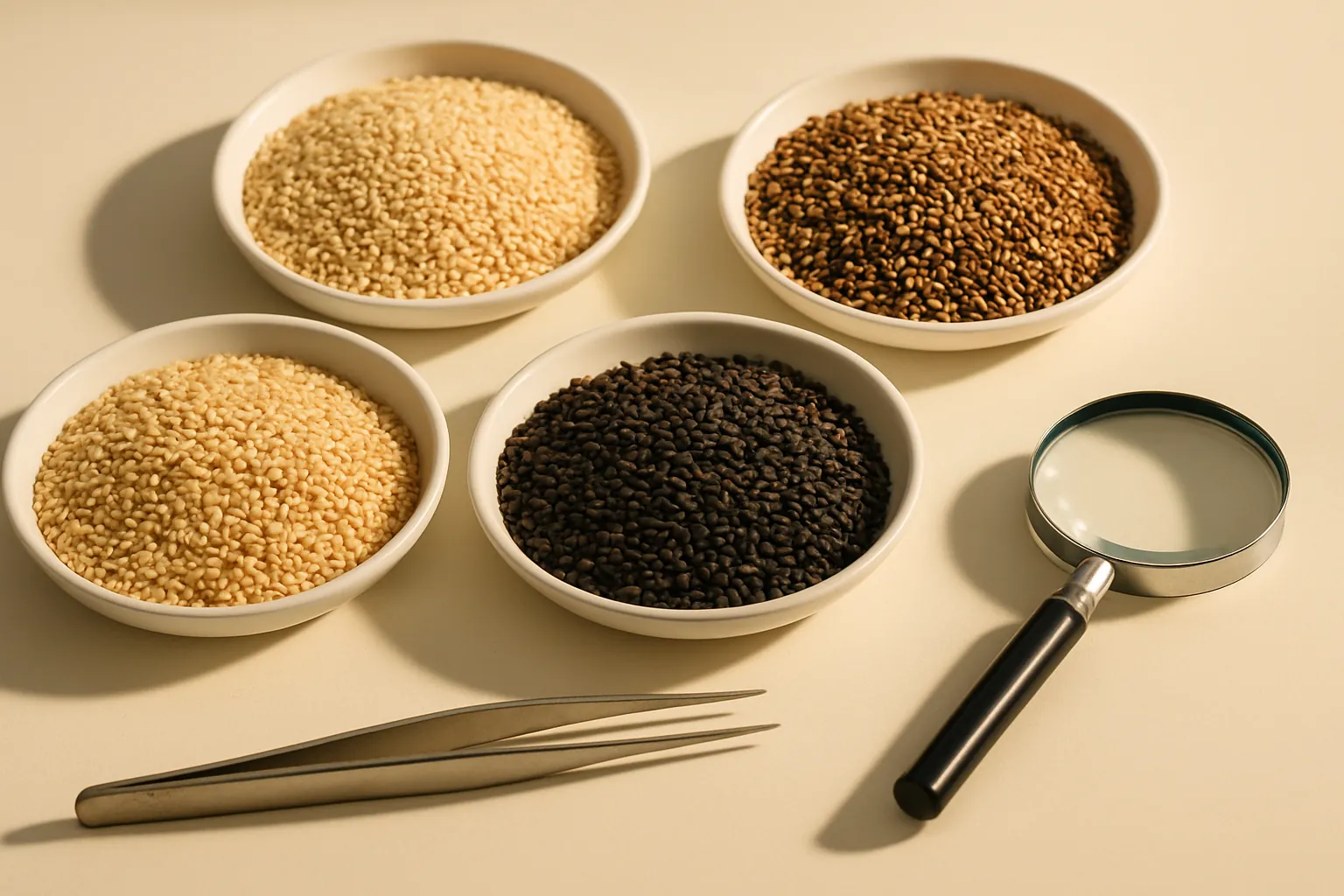
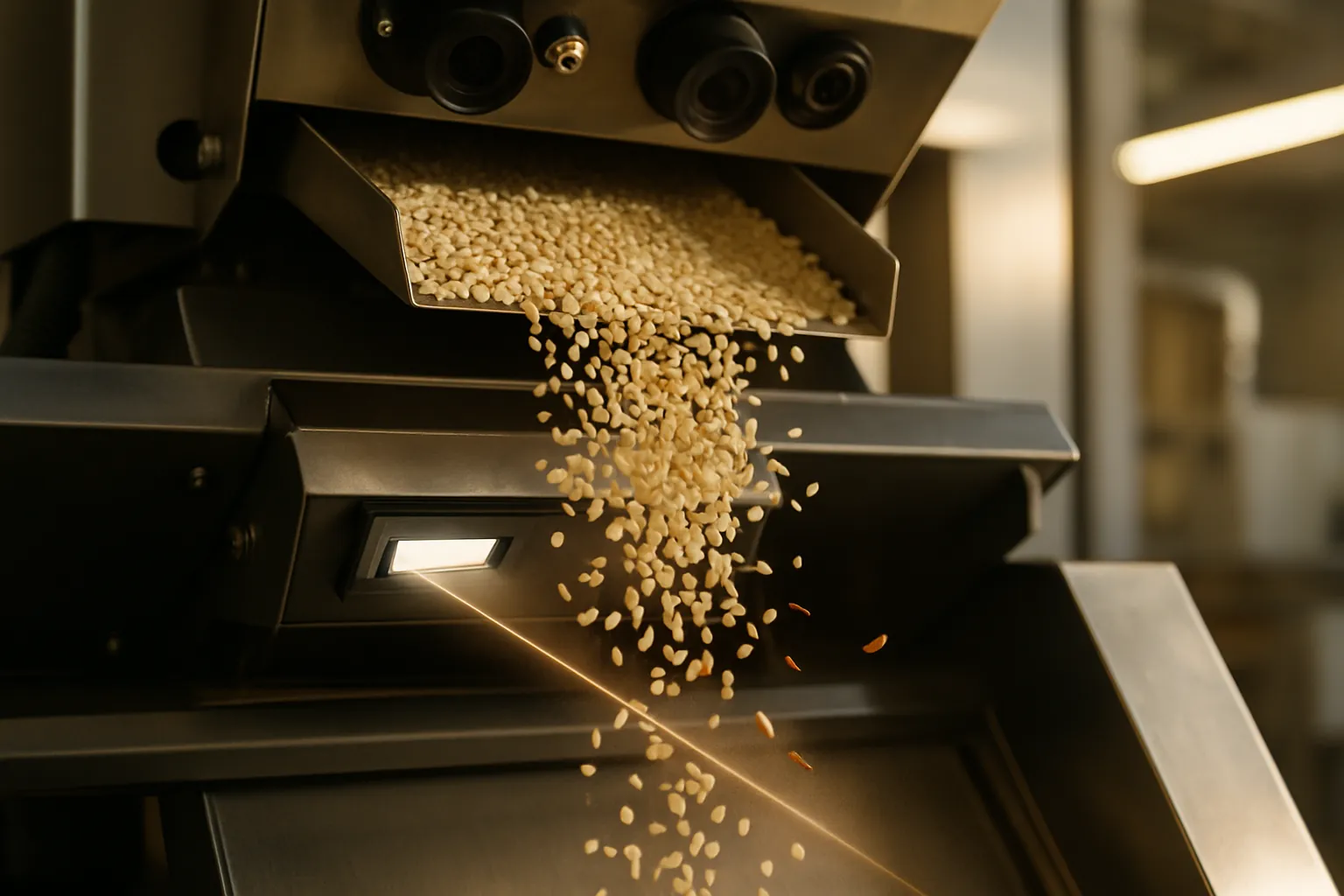
Optical sorting — 'sortex' in trade shorthand, after the machines that made the process standard — photographs every seed in flight and air-jets out anything the wrong colour: dark seed, discoloured seed, residual stones and stems. A sortex pass takes a 99 per cent lot to 99.95 per cent purity or better. The visible difference is dramatic: a sample dish of sortex seed is uniformly pale, with no dark specks. Buyers whose product displays the seed — bakery toppings, retail repacking, premium tahini — specify sortex; buyers who press or grind the seed often do not need it.
Natural vs hulled
Natural sesame keeps its seed coat; hulled sesame has it removed, usually by a wet mechanical process followed by drying and a sortex finish. The hull carries most of the seed's slight bitterness and its darker tone, so hulled seed is whiter, cleaner-tasting and slightly higher in oil by weight — typically 50 to 54 per cent against 48 to 52 for natural seed. Hulled sesame commands a premium and dominates in tahini for smooth pastes, burger-bun toppings and confectionery. The trade-off is nutritional: most of the seed's calcium sits in the hull, so natural seed retains it and hulled seed does not.
The four numbers on every lab report
- Purity — the percentage of sound sesame seed in the lot. 99% machine-cleaned; 99.95% sortex; 99.98% hulled.
- Oil content — 48–54% depending on grade and season. The value driver for crushers; assayed per lot.
- FFA (free fatty acid) — a maximum of 2% expressed as oleic acid. The freshness number: FFA rises as oil degrades, and high-FFA seed turns tahini and oil bitter.
- Moisture — a maximum of 6% for safe storage and transit; roasted seed is drier still, at 4% or below.
“Purity is what the seed looks like. FFA is what it will taste like in three months. A buyer who checks only the first number finds out about the second one from their customers.”
- Asha Ngonyani, Quality Manager
Admixture — the small number with big consequences
Admixture is everything in the bag that is not sesame. At 1 per cent on a 19-ton container, that is still 190 kilograms of material a buyer pays sesame prices for — which is why sortex lots at 0.05 per cent and hulled lots at 0.02 per cent carry the premiums they do. Admixture is also where field handling shows: seed threshed over tarpaulins arrives with a fraction of the stones and soil of seed beaten out on bare ground. Ask where a lot was threshed and you learn more than the spec sheet tells you.
Matching grade to end use
- Tahini and halva — hulled 99.98% for smooth premium pastes; natural 99% or sortex for traditional stone-milled styles.
- Bakery and burger-bun topping — sortex 99.95% natural or hulled; the seed is on display, so colour uniformity matters.
- Oil pressing — oil-grade bold seed at 52–54% oil; purity can relax to 98% because the press does not care about looks.
- Confectionery and snack bars — natural white 99% or hulled, depending on the finish the recipe needs.
- Sushi, furikake and seasoning — hulled roasted seed, ready to use with no further kitchen step.
Specifying with confidence
A complete sesame specification names six things, so the contract grade and the delivered grade describe the same seed: the seed type and form (natural white, sortex, hulled, brown), minimum purity with the admixture tolerance, minimum oil content, maximum FFA, maximum moisture, and the packaging format with net weight. We confirm each shipment against the agreed specification with independent lab analysis before despatch — that consistency, lot after lot, is what makes a supplier worth keeping.
Browse our sesame grades
- Wholesale sesame seeds supplier overview- grades, MOQ, testing and shipping in one place
- Natural White Sesame Seeds 99%- 99/1/1 · oil 48–52%
- Sortex Natural White Sesame 99.95%- optically cleaned · admixture ≤0.05%
- Hulled White Sesame Seeds- 99.98% · oil 50–54%
- Oil-Grade Sesame Seeds (Bold)- oil 52–54% · built for the press
- Sesame quality control: FFA, moisture & aflatoxin- How the numbers are verified
Related reading
Leave a Comment
Your email address will not be published.