

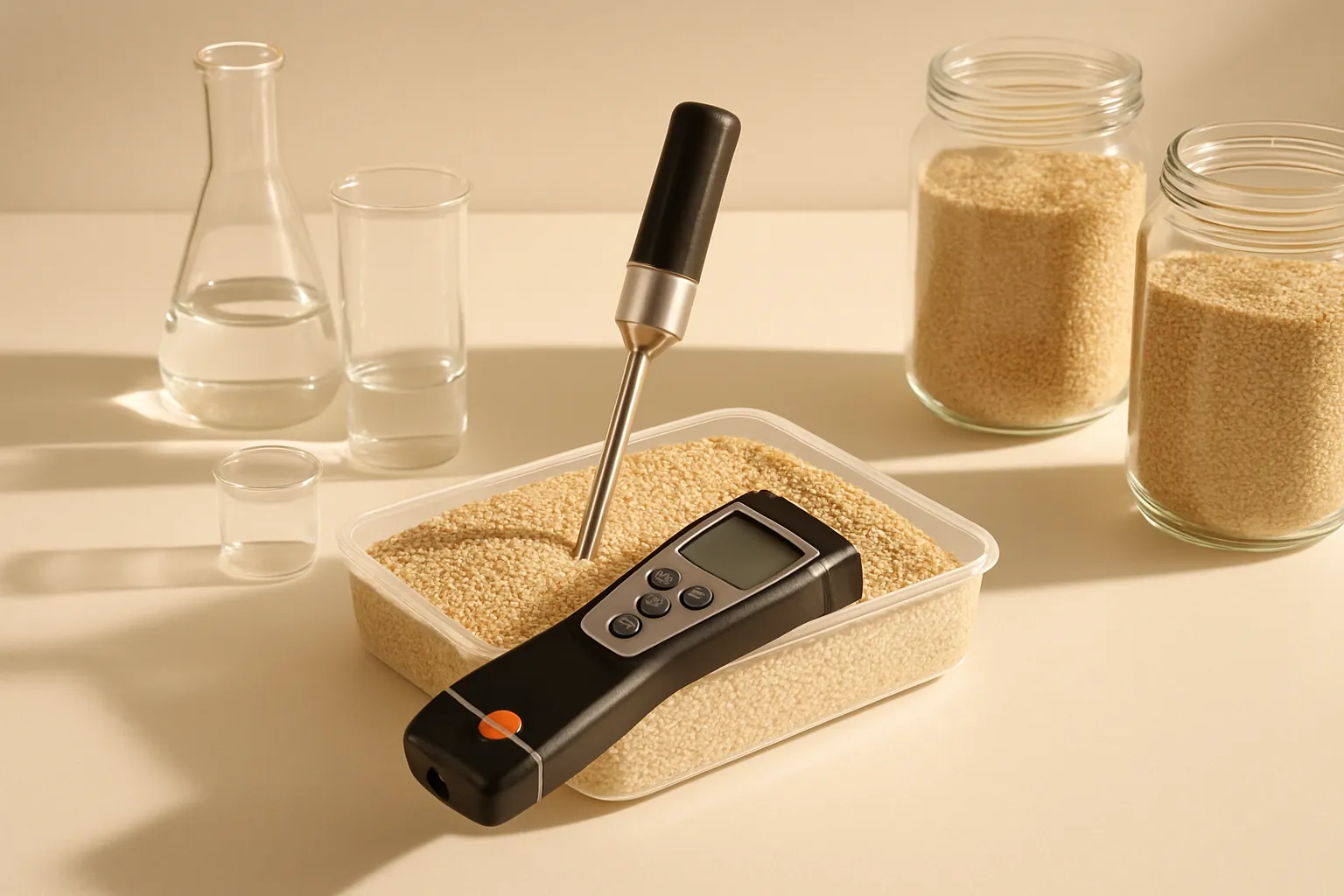
Sesame quality is not one test at the end — it is a chain of controls that begins in the field and is verified in the laboratory. Three measurements carry most of the weight: moisture, which governs whether the seed stores and ships safely; free fatty acid (FFA), which predicts whether the oil in the seed is fresh or quietly going rancid; and the food-safety screen — aflatoxin and salmonella — that importing markets enforce at the border. Here is how we hold each one, lot after lot.
Moisture: the number everything else depends on
Sesame is bagged at 6 per cent moisture or below — measured with calibrated meters at intake, never estimated. Above that level, three problems start at once: mould becomes possible in storage and transit, FFA begins to climb as enzymes and microbes get to work on the oil, and the seed can cake in the bag. The discipline behind the number is unglamorous: cutting and stooking in dry weather, threshing over tarpaulins, sun-drying on raised surfaces, and refusing wet lots at the warehouse door. Roasted sesame is held tighter still, at 4 per cent or below, because roasting is also a drying step.
FFA: the freshness meter
Free fatty acid measures how much of the seed's oil has broken down from its intact form — the first, invisible stage of rancidity. Export contracts cap it at 2 per cent expressed as oleic acid, and the difference between 0.8 and 1.8 per cent is the difference between a lot with a long shelf life ahead of it and one already spending its margin for error. FFA rises with moisture, heat, damaged seed and time; it never falls. That is why we assay it per lot at despatch — a low FFA at origin is the only guarantee that means anything by the time a container has crossed an ocean.
“Moisture is today's number; FFA is the record of every day before it. A lot can be dried down at the last minute, but it cannot un-age its oil — which is why we test both.”
- Asha Ngonyani, Quality Manager
Aflatoxin: lower risk than nuts, zero excuse
Sesame carries a lower aflatoxin risk than groundnuts or tree nuts, but lower is not none — Aspergillus moulds will grow on any oilseed stored damp and warm. Prevention is the same discipline as moisture control: dry fast, bag dry, store ventilated and off the floor. Verification is laboratory testing on representative samples drawn across each export lot, against the limits of the destination market — the EU's thresholds for oilseeds being the strictest we routinely certify against. Results are documented per lot and travel with the shipping documents.
Salmonella: sesame's particular burden
The sesame trade's most consequential food-safety issue in recent years has not been aflatoxin but salmonella — the organism behind repeated recalls of tahini and sesame products internationally, and the reason several importing jurisdictions now require salmonella certification on sesame consignments. Because so much sesame ends up in ready-to-eat products, we treat every lot as if it were destined for one: hygienic handling from threshing tarpaulin to bagging line, no contact with bare soil after harvest, and per-lot laboratory screening before despatch.
The control chain, end to end
- Field: cut and stook in dry weather; thresh over tarpaulins, never bare ground.
- Intake: moisture metered at 6% max; visibly damp, caked or off-odour lots refused.
- Cleaning: sieving, destoning and air separation to 99%; sortex to 99.95% where specified.
- Storage: ventilated warehouse, bags palletised off the floor and clear of walls.
- Despatch: independent lab analysis per lot — purity, oil, FFA, moisture, aflatoxin, salmonella.
- Documentation: every result tied to the lot number on the bill of lading.
For a buyer, the takeaway is that a compliant sesame shipment is the predictable output of a managed process, not luck with a particular crop. Ask any supplier not just for their specifications but for their control points — where they measure, what they refuse, and what paper follows the lot. The answers separate exporters who manage quality from exporters who merely describe it.
Related reading

Leave a Comment
Your email address will not be published.