

At a glance
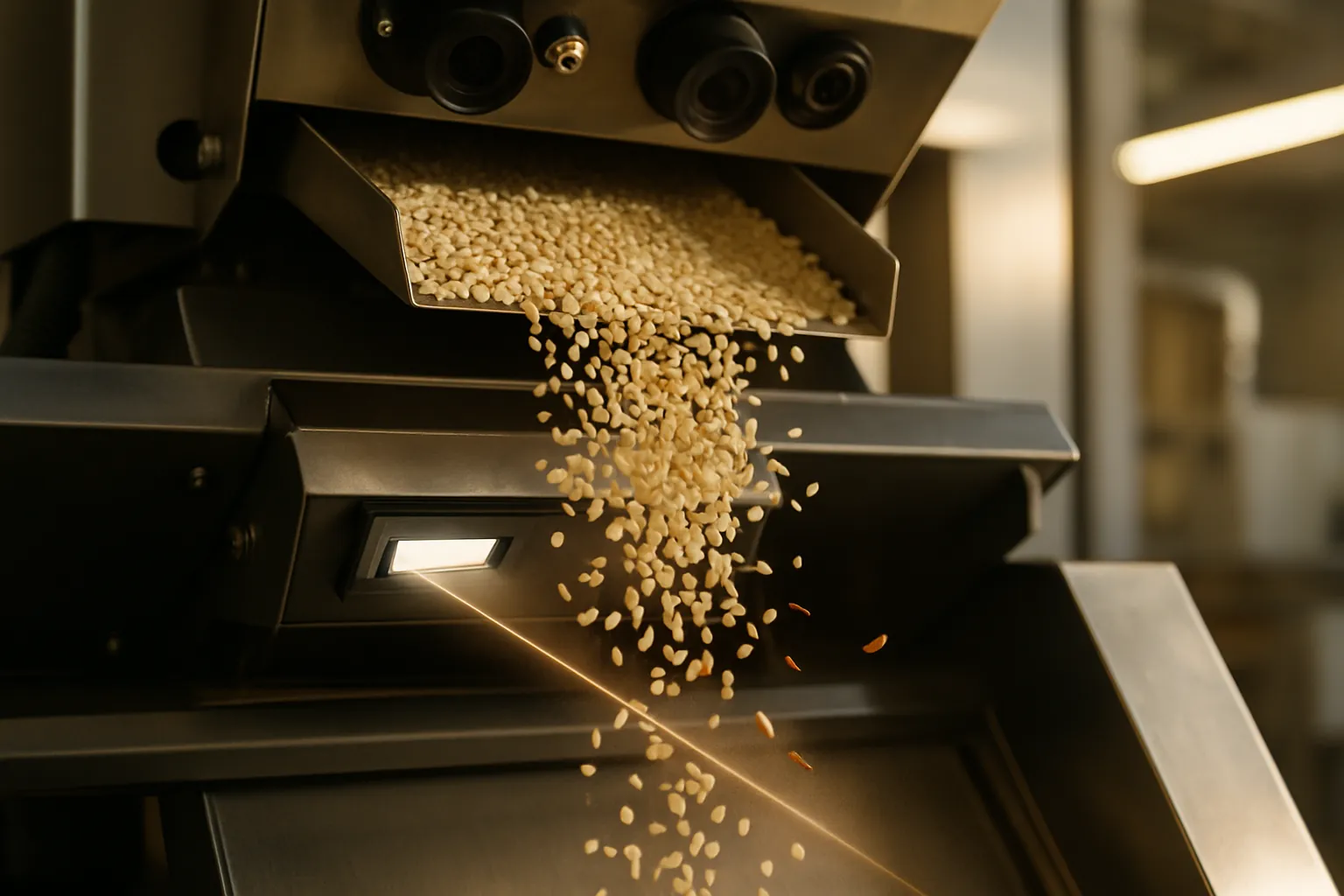
- Optical ('sortex') sorting photographs every seed in free fall and air-jets out anything that does not match — dark seed, stones, glass, stems, other grains — at thousands of ejections per minute.
- It is the final cleaning stage: field-cleaned seed is machine-cleaned to 99/1/1 by sieving, destoning and air separation, then optically sorted to 99.95% purity.
- The pass cuts admixture from 1% to around 0.05% — on a 19–20 MT container, roughly 180 kg less non-sesame material bought at sesame prices.
- Pay the sortex premium when the seed is on display or milled into premium pastes — bakery toppings, retail repacking, tahini; oil pressers usually should not.
- Cameras cannot see moisture, FFA, aflatoxin or salmonella — a sortex pass never replaces the per-lot laboratory report.
- Specify by number: 99.95% purity min, 0.05% admixture max, 6% moisture max, 2% FFA max, plus per-lot food-safety testing.
A sesame seed weighs about three milligrams; an export container carries nineteen to twenty tonnes of them — billions of seeds. A premium buyer expects no more than five grams of anything else in every ten kilograms. The only technology that keeps a promise that precise at commercial speed is optical sorting — 'sortex' in trade shorthand, after the machines that made the process standard. Here is what the machine actually does, how a lot reaches our flagship 99.95 per cent grade, when the premium is worth paying, and where the camera's competence ends.
What does an optical sorter actually do with a seed as small as sesame?
It photographs every seed individually and knocks the bad ones out of the air. Seed leaves a vibrating feeder and inclined chute as a thin, fast-moving curtain; cameras image each seed in free fall from both sides, and anything the wrong colour, shape or reflectance triggers a compressed-air jet that deflects it into the reject stream within milliseconds.
The scale is what makes it remarkable. A sesame seed is two to three millimetres long, the curtain moves metres per second, and every seed gets its own accept-or-reject decision — ejectors fire thousands of times per minute. Colour cameras catch dark, discoloured and immature seed; laser channels read how a surface scatters light, exposing stones, glass and stem fragments that happen to be seed-coloured; and newer machines run trained classifiers that learn a lot's acceptable range rather than applying one fixed threshold. Because ejectors inevitably take some good seed with each reject, the reject stream is re-sorted to recover it.
How does a lot get from the field to 99.95% purity?
In three stages, each removing what the previous one cannot. The sorter only delivers 99.95 per cent because everything upstream has already done its share.
- Field cleaning — cutting, stooking and threshing over tarpaulins keeps soil, sand and stone out of the seed in the first place; winnowing takes the light chaff.
- Machine cleaning — sieving removes anything the wrong size, the destoner separates by density, and air aspiration lifts out dust and light matter. The result is natural white 99/1/1 — 99% pure seed, 1% admixture max, 1% other-coloured seed max.
- Optical sorting — the sortex pass judges each remaining seed by colour and reflectance, removing defects that are the right size and weight but the wrong seed. The result is 99.95% purity with admixture around 0.05%.
The order matters. Feed a sorter uncleaned seed and the ejectors fire constantly, good seed pours into the reject stream and throughput collapses. Sieving, destoning and aspiration remove the bulk contamination cheaply; the cameras then spend their precision on the defects nothing else can find. The two stages are complements, not alternatives.
Why does the purity premium exist — and when should you pay it?
Because the pass costs real money, and what it removes is exactly what a consumer sees. Machine time, energy, yield lost to the reject stream and tighter inspection all price into a sortex tonne — and they buy the difference between a topping with dark specks and one without. On a 19–20 MT container, moving from 1 per cent admixture to 0.05 per cent also means roughly 180 fewer kilograms of non-sesame material bought at sesame prices.
The buying rule follows the end use. Specify sortex when the seed is on display or identity-critical: bakery and burger-bun topping, retail repacking, premium tahini and halva where roast colour must hold batch to batch. Skip it when the seed is pressed — oil-grade lots are bought on assayed oil content, and the press does not care what the seed looks like. Sortex is a visual-quality premium, and it repays buyers whose product is judged visually; our grades and specs guide and the natural vs hulled guide cover the rest of the decision.
What can optical sorting not do?
Anything a camera cannot see. Moisture, free fatty acid, aflatoxin and salmonella are invisible at any resolution — a visually flawless lot can still fail on all four. Moisture is metered at intake and capped at 6 per cent; FFA is assayed in the laboratory and capped at 2 per cent as oleic; aflatoxin and salmonella are screened per lot against the destination market's limits. A supplier who answers a food-safety question with 'it is sortex cleaned' is answering a different question — our quality-control guide sets out the tests that actually rule.
“The sorter is the best eyesight in the plant, and eyesight is all it is. It will find one dark seed in ten thousand and wave through a lot that fails on aflatoxin without blinking. The camera and the lab answer different questions — a serious buyer asks both.”
- Asha Ngonyani, Quality Manager
How should you specify a sortex lot in the contract?
- Name the grade by number, not adjective — 'sortex natural white sesame, 99.95% purity minimum, 0.05% admixture maximum', never just 'sortex-cleaned'.
- Keep the chemistry caps alongside it: moisture 6% max, FFA 2% max as oleic, and a minimum oil content if you press or grind.
- Require per-lot laboratory testing — aflatoxin and salmonella against your destination market's limits — regardless of how the seed was cleaned.
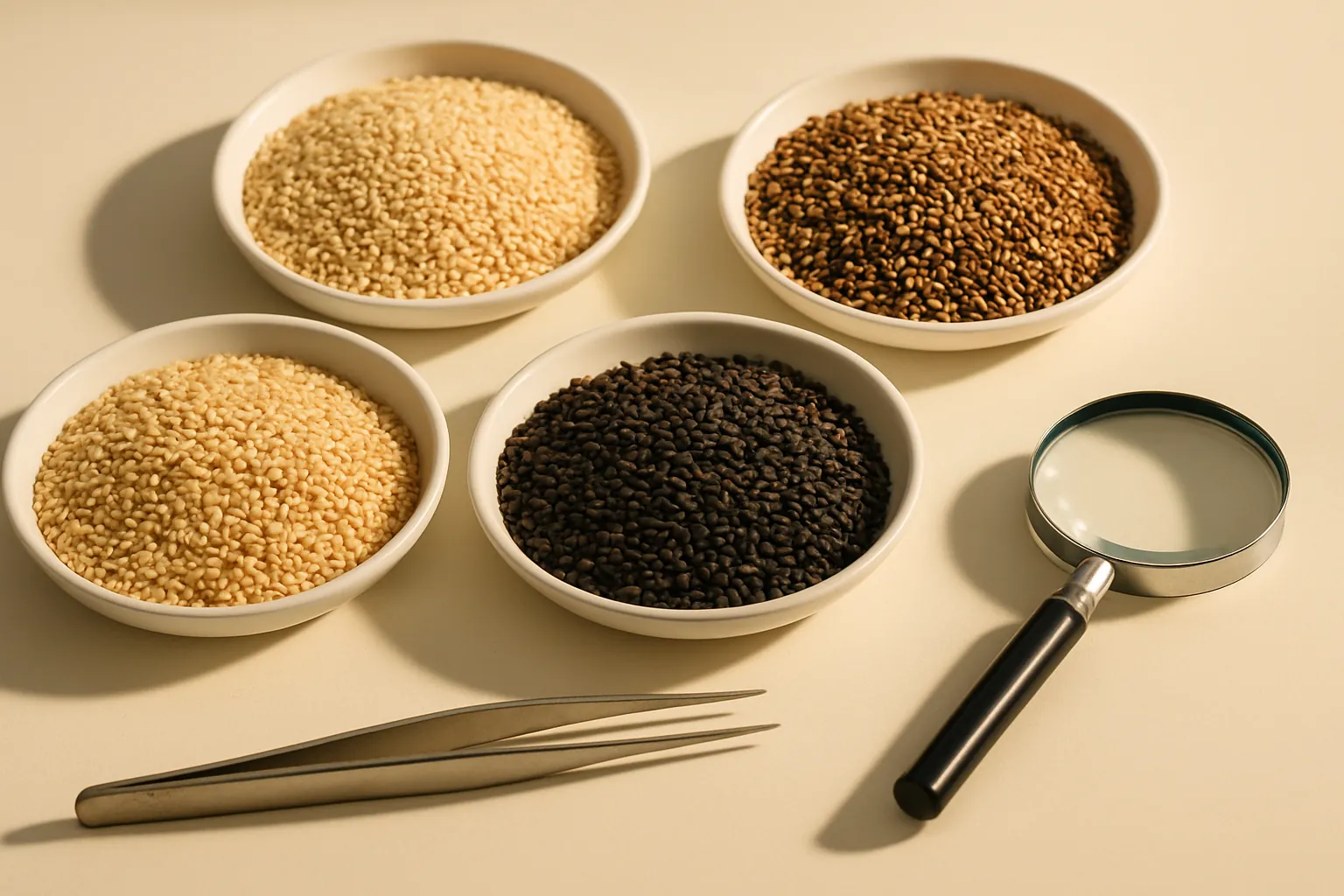
- Ask for and retain a pre-shipment sample drawn across the lot; a sortex claim can be verified in a sample dish.
- Prefer single-origin lots tied to a named growing district — uniform base colour is what the sorter's calibration is set against.
- Agree packaging that protects the work: clean 25/50 kg PP bags or lined packing, because a 99.95% lot contaminated in a dirty container is a 99% lot again.
If your line cannot tolerate dark specks, the proof is cheap: ask us for a sortex sample dish alongside a 99/1/1 dish from the same origin and put them side by side. We quote both grades on the same documentation, so the premium — and what it buys — is visible before you commit a container.
Specify with confidence
- Sortex Natural White Sesame 99.95%- The flagship optically sorted grade
- Natural White Sesame Seeds 99%- The machine-cleaned 99/1/1 baseline
- Hulled White Sesame Seeds- Sortex-finished to 99.98% purity
- Sesame grades & specs explained- The full specification ladder
- Natural vs hulled sesame: buyer's guide- The other fork in the buying decision
- Sesame quality control: FFA, moisture & aflatoxin- The lab tests no camera can replace
Related reading
Leave a Comment
Your email address will not be published.