

At a glance
- Natural white sesame keeps its seed coat; hulled sesame has the coat mechanically removed, then re-dried and sortex-finished.
- Hulling loses roughly 8–10% of seed weight as discarded hulls — a yield loss priced into every hulled tonne.
- Oil content: natural runs 48–52%; hulled runs 50–54%, because the hull adds weight but little oil.
- Calcium: natural seed carries roughly 900–1,000 mg per 100 g, most of it in the hull; hulled seed keeps only a fraction.
- Purity conventions: natural trades at 99/1/1 (sortex 99.95%); hulled trades at 99.98%.
- Rule of thumb: seed on display or milled smooth → hulled; oil pressing, whole-seed bakery and calcium claims → natural.
Natural or hulled is the first fork in every sesame purchase, and the honest answer depends on where the seed ends up. Choose natural white sesame when you press oil, bake whole-seed products or want the seed's full calcium story; choose hulled sesame when the seed is on display, milled into smooth tahini or eaten where the hull's slight bitterness would show. The two forms are priced differently for a mechanical reason — hulling throws away 8 to 10 per cent of the seed's weight — and specified differently on every contract. Our grades and specs guide explains the specification terms; this guide answers the buying question: which form, for which product.
What is the difference between natural and hulled sesame seeds?
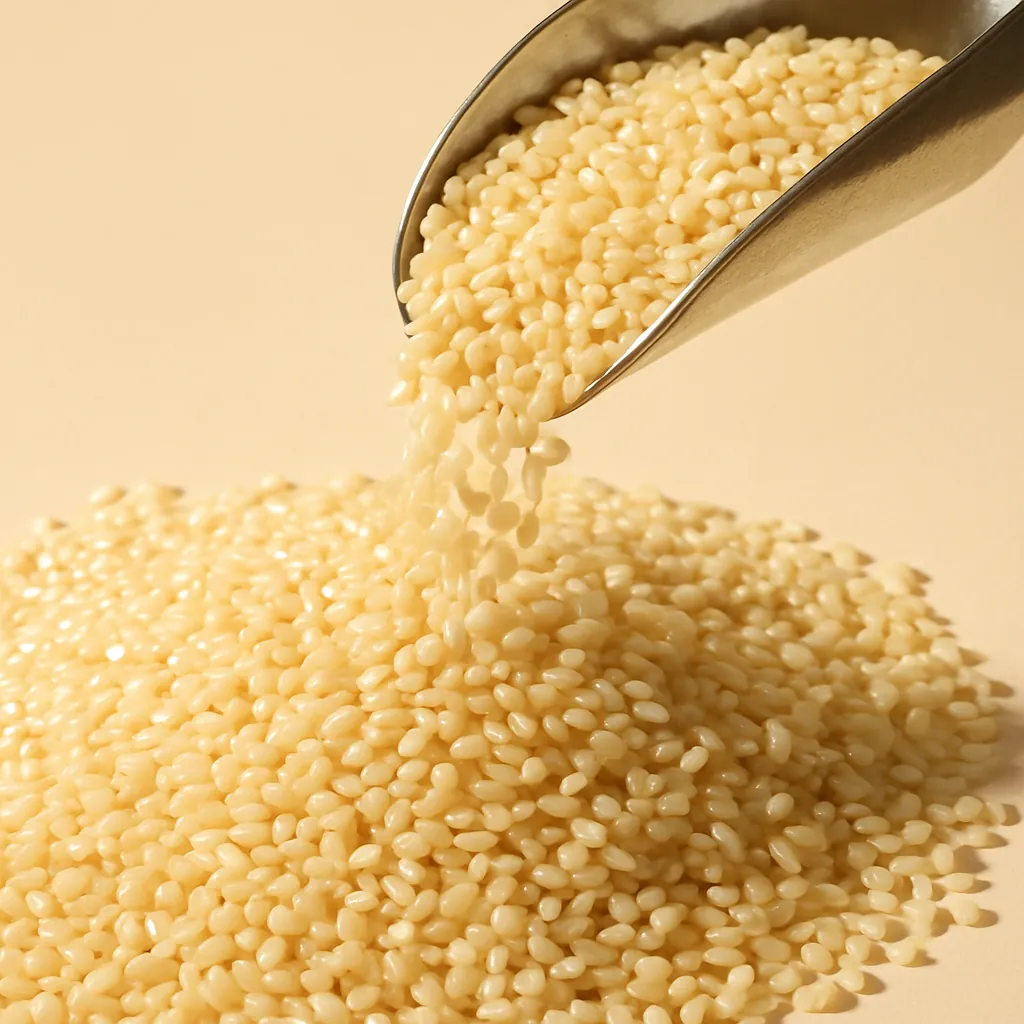
Natural sesame keeps its seed coat; hulled sesame has the coat removed, usually by a wet mechanical process, then dried back down and finished on an optical sorter. The result is a whiter, cleaner-tasting, slightly higher-oil seed — typically 50 to 54 per cent oil against 48 to 52 for natural — trading at 99.98 per cent purity. What leaves with the hull matters as much as what stays: most of the seed's calcium, most of its slight bitterness and its darker tone all sit in the coat.
Why does hulled sesame cost more?
Because the premium is mostly arithmetic. Three costs stack: hulling loses roughly 8 to 10 per cent of the seed's weight as discarded hulls, so 100 tons of natural seed becomes roughly 90 to 92 tons of hulled; the dehulling, re-drying and sortex-finishing steps add real plant cost per ton; and the finished product carries a tighter specification — 99.98 per cent purity with admixture near 0.02 per cent. A hulled quote that is not meaningfully above the natural quote deserves suspicion, not celebration.
Which should tahini producers buy?
Smooth commercial tahini and halva run on hulled seed — no hull specks in the paste, no bitterness to mask, higher oil for a silkier grind. Traditional stone-milled tahini styles, where a fuller flavour is the point, are made on natural or sortex natural seed. If roast-colour consistency batch to batch drives your customer complaints, single-origin hulled lots are the safer buy.
Which is better for bakery and toppings?
When the seed is visible — burger buns, bagels, breadsticks, retail repacking — colour uniformity decides, and buyers specify hulled or sortex-cleaned 99.95 per cent natural. For rustic and whole-grain breads, crackers and seed mixes where texture, fibre and the calcium story are selling points, natural white 99/1/1 does the job at a lower cost per ton.
Which is better for oil pressing?
Natural — specifically bold, oil-grade seed assaying 52 to 54 per cent oil. The press does not care what the seed looks like, so paying the hulling premium buys nothing; purity can even relax toward 98 per cent. Price oil-grade lots on a per-lot oil assay, not an origin average.
How do shelf life and nutrition compare?
The intact hull is the seed's own packaging, so natural sesame stores more forgivingly; hulled seed exposes the kernel and should be held to tight moisture with food-grade liners in the bag or carton. Both forms are capped at 2 per cent FFA at despatch in a well-written contract. Nutritionally, the split is calcium: natural seed carries roughly 900 to 1,000 milligrams per 100 grams, most of it in the hull — so a calcium-led product must be built on natural seed, and a hulled-based product should quote the lower figure honestly.
Spec checklist: what to fix in the contract
- Form and grade — natural white 99/1/1, sortex 99.95%, or hulled 99.98%, each written with its admixture tolerance.
- Minimum oil content if you press or grind — assayed per lot, not quoted as an origin average.
- Maximum FFA of 2% as oleic and maximum moisture of 6% (4% for roasted seed).
- Food-safety protocol — aflatoxin and salmonella screening per lot against your destination market's limits.
- Packaging — 25/50 kg PP bags, 1 MT jumbos, or lined cartons for roasted seed.
- A retained pre-shipment sample, so the delivered container can be verified against what was agreed.
“Buyers rarely regret the form they chose; they regret paying for a number their product never uses. If the hull ends up in a press cake or a rustic loaf anyway, keep it — and keep the money.”
- Asha Ngonyani, Quality Manager
If you are weighing the two forms for a specific product, send us the end use and the destination and we will quote natural and hulled side by side — same origin, same documentation — so the premium and the yield maths are visible before you commit a container.
Compare the grades
- Wholesale sesame seeds supplier overview- grades, MOQ, testing and shipping in one place
- Natural White Sesame Seeds 99%- 99/1/1 · oil 48–52%
- Hulled White Sesame Seeds- 99.98% · oil 50–54%
- Sortex Natural White Sesame 99.95%- Optically cleaned natural seed
- Oil-Grade Sesame Seeds (Bold)- 52–54% oil, built for the press
- Sesame grades & specs explained- Purity, oil, FFA and the 99/1/1 convention
- The nutrition benefits of sesame seeds- The calcium and lignan story in detail
Related reading
Leave a Comment
Your email address will not be published.