

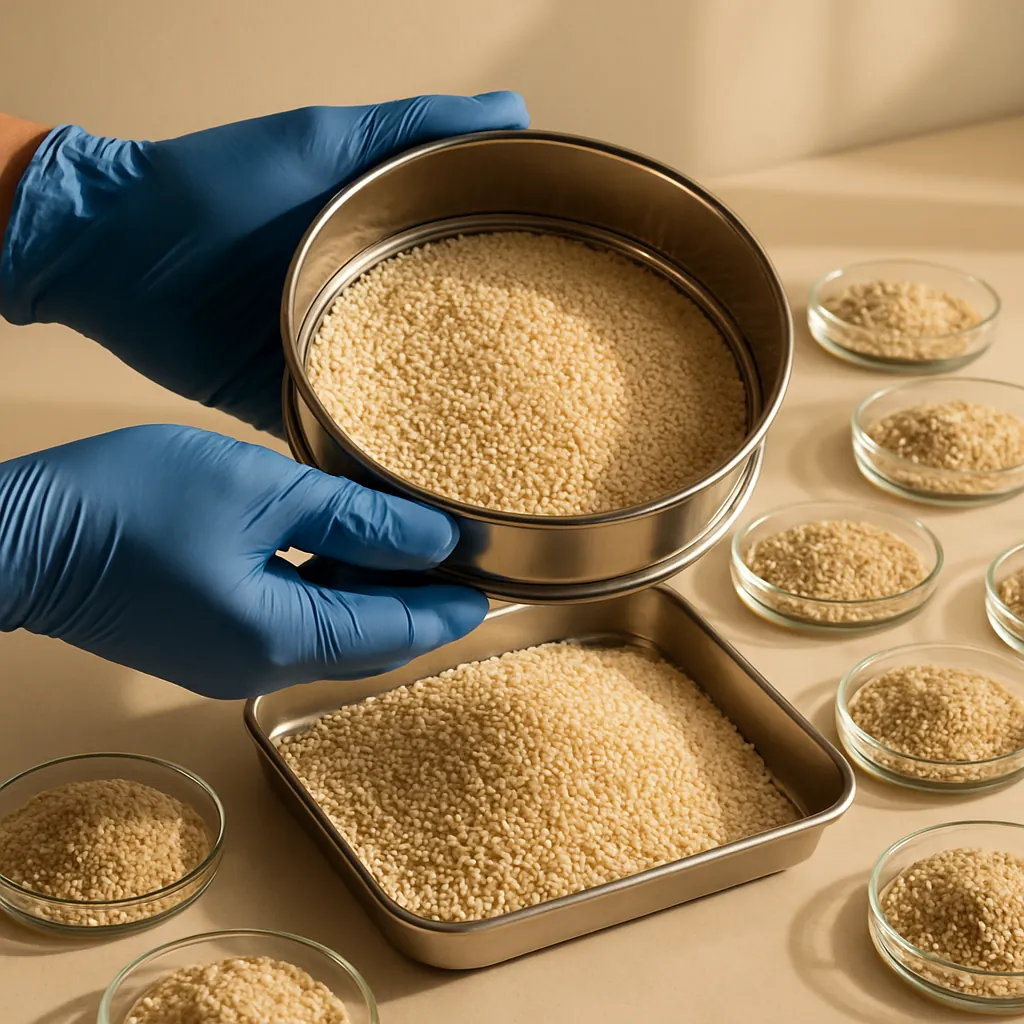
Compare natural and hulled sesame lot reports only after checking that each report identifies the seed being offered, the sampled lot, the test method, the units and the agreed specification. Put the actual results beside the contract limits. If a report describes natural seed before hulling while the offer is for finished hulled seed, ask for evidence covering the finished lot before making an acceptance decision.
A certificate of analysis (COA) records results for a sample associated with a lot. A product specification describes what the supplier agrees to deliver. Keep both documents open: a specification sheet showing a minimum purity is not evidence that a particular lot achieved it. This guide gives procurement and quality teams a way to compare the paperwork without treating every percentage as interchangeable.
Qualify the seller and processing route separately from the lot.
1. Match the report to the seed and the shipment
Start with identity before reading the results. Natural sesame retains its seed coat; hulled sesame has had that coat removed. Optical sorting is a separate operation, so a report saying only “white sesame, sortex” leaves the product form unclear. Ask the supplier to identify the form and grade explicitly.
- Match the COA lot or batch identifier to the offered lot and the packing-list reference. Ask for a written mapping if processing or packing creates a new identifier.
- Record the sample date, analysis date and report issue date separately. A newly issued copy does not necessarily mean a new sample was tested.
- Check whether sampling occurred before or after cleaning, hulling, roasting or repacking. Record which finished goods the sample represents.
- Keep the report number, laboratory identity and any revised report together. Ask what changed when a replacement report arrives.
A sample from incoming natural seed can help describe that incoming material. It does not by itself establish the condition of the finished hulled lot. Ask how the supplier links the processing record, finished-lot identifier and supporting analysis. Do not fill that gap with an assumption that a cleaner-looking seed must have passed every test.
2. Separate the grade claim from the measured result
Afri Exports lists natural white 99%, sortex white 99.95% and hulled white 99.98% grades. These are catalogue specifications, not readings from the lot currently offered. Use the relevant grade as a starting point, then compare the actual report with the specification agreed for your order. Availability and suitability still need confirmation for that enquiry.
For purity and admixture, ask what the method counts in each category. Keep hull fragments, other seeds, foreign matter and colour defects in separate fields where your specification treats them separately. Do not assume two suppliers use the same definition simply because both reports show a purity percentage. A high purity result also does not replace the other analyses your quality team requires.
3. Check methods, units and reporting basis
Build a comparison sheet with one row per parameter and a separate column for each lot. Copy the parameter name, actual result, unit, test method, reporting basis and applicable contract limit. Leave missing fields marked “clarification required”. A blank field is not a passing result.
- Moisture: record the method and the sampled product form. Ask the laboratory to explain comparability if the reports use different methods.
- Oil: ask whether the result is reported on the seed as received or on a dry basis. Obtain a comparable result or a laboratory explanation before ranking the lots by oil percentage.
- FFA: copy the full expression and unit, including the stated reference acid where applicable. Ask for clarification if one report says only “acidity”.
- Purity and admixture: keep the method and counted categories alongside the percentage. Confirm that each result answers the same purchase specification.
Avoid doing an informal conversion to make two reports look comparable. The laboratory should confirm what was measured and how it relates to the contracted requirement. For oil pressing, a laboratory oil result and your own extraction yield are separate questions; use an agreed processing trial if yield is central to the purchase decision.
4. Read food-safety entries as specific test results
Ask your quality team to define the required analyses for the intended use and destination before comparing offers. Check that the report includes those analyses, rather than assuming a supplier’s standard panel covers your order. Requirements need confirmation for the actual product and market; this guide does not provide a universal import checklist.
For a contaminant result, retain the named substance, unit, method and reporting limit. If a result says “not detected”, ask for the detection or reporting limit so your quality team can interpret it. For a microbiological entry, retain the organism, method and stated test portion or sampling information. Ask for the full report if a summary reduces all of this to “pass”.
Keep physical grade acceptance and food-safety review as separate decisions. A purity result cannot answer a question about Salmonella, pesticide residues or aflatoxin. Equally, an analysis that was never requested or reported cannot be treated as evidence of absence. Escalate missing or unclear evidence to the person responsible for approving the ingredient.
5. Compare two offers without inventing a winner
Use this document comparison when you receive a natural-seed offer and a hulled-seed offer. It is a checklist, not an example shipment or a set of laboratory results.
- Identity row: natural lot identifier versus finished hulled lot identifier. Both must be traceable to the goods offered.
- Processing row: record when each sample was drawn. If the hulled offer carries only a pre-hulling report, request finished-lot evidence.
- Purity row: enter each agreed grade and actual result. Compare each with its own specification; do not choose the form solely by the larger purity number.
- Oil and FFA rows: retain methods, units and reporting basis. Mark the comparison unresolved until missing details are supplied.
- Food-safety rows: check the evidence against the analyses agreed for the intended use and destination. Record unanswered questions.
- Decision row: write “meets agreed specification”, “clarification required” or “does not meet agreed specification”, with the reviewer and reason.
Choose the form for the product you manufacture, then assess the offered lot against that requirement. If the documents are incomplete, request clarification before acceptance. If the results fail the agreed specification, use the agreed rejection or corrective-action process. A commercial deadline does not make an unresolved report comparable.
6. Close the document trail before accepting the lot
Save the agreed specification version, offer, full laboratory report, lot mapping and review decision together. Agree who draws any further sample, what goods it represents, which methods will be used and how a disagreement will be resolved. Follow your own quality procedure for retaining samples and approving material; do not replace it with a supplier’s summary.
For an Afri Exports enquiry, send the natural or hulled form, grade, intended use, quantity, destination and required analyses. Include your specification and the report fields your quality team needs. Our sesame catalogue covers both natural and hulled grades; the documents and terms for the proposed lot must be confirmed through the enquiry.
Compare grades and prepare your enquiry
- Natural versus hulled sesame: choosing the form- Choose for your manufacturing use.
- Sesame grades and specifications- Read the catalogue grade terms.
- Sesame quality control- Background on the quality parameters.
- Natural White Sesame 99%- Natural grade product details.
- Hulled White Sesame- Hulled grade product details.
- Wholesale sesame supplier overview- Prepare a grade-specific enquiry.
Further reading on laboratory reports
Related reading
Leave a Comment
Your email address will not be published.