

At a glance
- White and black sesame are the same species — Sesamum indicum — separated by the colour and pigment of the seed coat.
- Buy white for volume: bakery toppings, tahini, halva, confectionery, oil pressing and retail repacking.
- Buy black for effect: visible garnish, East Asian cuisine, furikake and gomashio blends, dark pastes and pigment-led retail packs.
- Black is always sold with its hull on — hulling would remove the colour that defines it. White is sold both natural and hulled.
- Flavour: black is stronger, nuttier and faintly bitter; white is milder and slightly sweeter, and hulled white is the mildest of all.
- Oil: white and brown are the pressing seeds (48–52% and 50–54% respectively); black typically assays lower and is rarely crushed commercially.
- Market size: white dominates the global bulk trade; black is a much smaller specialty stream concentrated in East Asian food manufacture.
- We supply natural white, sortex white, hulled white and natural brown from Tanzania. We do not supply black sesame.
White and black sesame come off the same botanical species, and the only material difference between them is the seed coat. That one difference redirects everything downstream: how the seed can be processed, what it tastes like, how much oil it carries and who buys it. For a bulk buyer the short answer is that white sesame is the commodity and black sesame is the garnish. This guide sets the two side by side, and is honest about which of them we ship.
What is the difference between white and black sesame seeds?
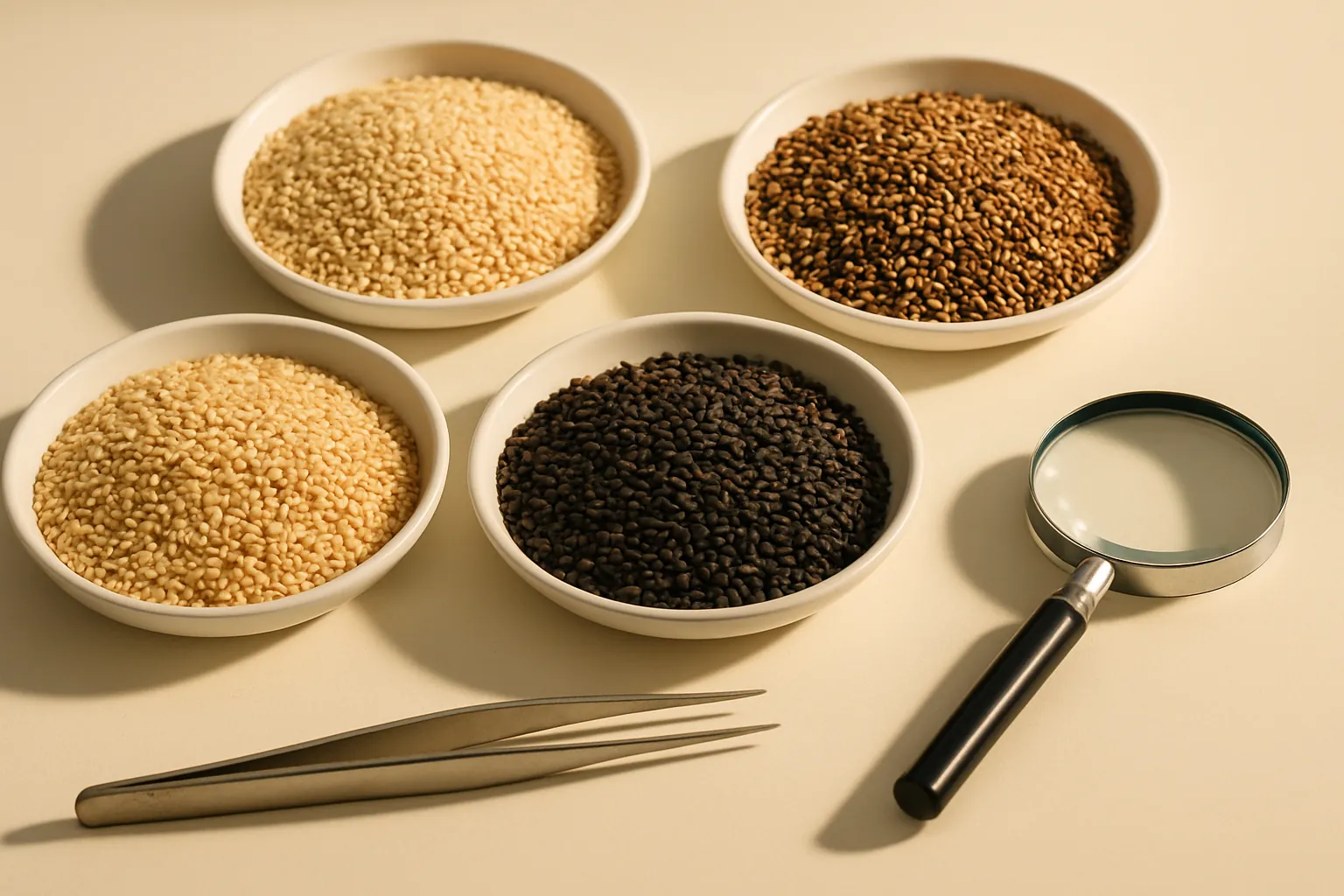
The difference is pigment in the seed coat. White sesame runs from creamy-white to off-white and is graded partly on how uniform that colour is across the lot; black carries a dark, matte coat coloured by pigments concentrated in the hull; brown sits between them. Seed size is broadly comparable, though black varieties are often slightly smaller and flatter. One commercial point matters early: in a white lot, dark seed is a defect, not a variety. The 99/1/1 convention allows a maximum of 1 per cent other-coloured or damaged seed, and sortex cleaning exists largely to push that share lower still.
Does black sesame keep its hull?
Yes, always. Hulling strips the seed coat off, and with black sesame the coat is the point of the seed. That makes the natural-versus-hulled fork a white-sesame decision only. Black keeps everything the hull carries — fibre, the minerals held in the coat, the darker tone and the faint bitterness — and can never be made whiter or milder by processing. White can be bought natural, sortex-cleaned for colour uniformity, or hulled for the whitest, cleanest-tasting seed; our natural versus hulled guide walks through that second decision by end use.
How do flavour and aroma compare?
Black sesame is the more assertive seed: nuttier, deeper, faintly bitter and markedly more aromatic once toasted. White is milder and slightly sweeter, and hulled white — with the bitterness of the coat removed — is the mildest form on the market. The formulation implication is simple. Black is chosen where the sesame is meant to be seen and tasted in its own right; white is chosen where sesame supports a product without dominating it, which is why it carries the tahini, halva, confectionery and bakery trades. Swapping one for the other moves the appearance and the flavour balance at once.
Which has more oil — white or black sesame?
White and brown are the oil seeds of the trade. Our natural white assays 48 to 52 per cent oil and the bold southern brown lots run 50 to 54 per cent, which is why crushers work from those two colours. Black typically assays lower and is rarely bought for commercial pressing; it reaches the consumer whole or ground into paste. If you are buying to press, ignore colour and buy on the number: a per-lot oil assay rather than an origin average, with the contract held to 2 per cent maximum FFA as oleic and 6 per cent maximum moisture.
Which sesame do bakeries and tahini producers buy?
White, overwhelmingly. Where the seed sits on the crust — burger buns, bagels, breadsticks, crackers — buyers specify hulled or sortex-cleaned 99.95 per cent white, because uniform colour is what the premium buys. Tahini and halva run on hulled white for a smooth, speck-free paste, while traditional stone-milled styles use natural or sortex natural seed. Confectionery is a white-seed trade too. Black does appear in bakery, but as deliberate contrast: dark-seeded buns, black sesame breads and filled pastries — real product lines, ordered in far smaller quantities than the white lines beside them.
Where is black sesame actually used?
Its home is garnish and seasoning. Black sesame tops sushi, rice bowls and noodle dishes across Japanese, Korean and Chinese cooking; it defines furikake rice seasonings and gomashio, the toasted sesame and salt blend; and it is ground into the dark, aromatic pastes used for dessert fillings, ice creams and sweet soups. Outside food manufacture it sells in health-positioned retail packs, where the pigment itself is the story. In all of these the seed is visible and tasted directly — the opposite of the bulk white trade, where sesame disappears into a paste or a press.
White vs black sesame: the side-by-side
- Seed coat — white: sold natural with the coat intact, sortex-cleaned, or hulled. Black: always natural, hull retained; hulling would remove the colour.
- Appearance — white: creamy to off-white, graded on colour uniformity. Black: uniform matte dark coat; off-colour white or brown seed is the defect buyers screen for.
- Flavour — white: mild, slightly sweet, cleanest when hulled. Black: stronger, nuttier, faintly bitter, more aromatic when toasted.
- Oil content — white: 48–52% in our natural grade, the mainstream pressing seed alongside brown at 50–54%. Black: typically lower and seldom crushed commercially.
- Primary end uses — white: bakery toppings, tahini and halva, confectionery, oil pressing, retail repacking. Black: garnish, sushi and East Asian cuisine, furikake and gomashio, dark pastes, pigment-led health packs.
- Processing route — white: cleaned to 99/1/1, sortex-finished to 99.95%, or hulled to 99.98%. Black: cleaned and graded natural, with a maximum share of off-colour seed specified.
- Buyer markets — white: Japan, China, Turkey, Israel, the wider Middle East, EU bakery and tahini industries. Black: East Asian food manufacture, plus specialty and diaspora retail elsewhere.
- Trade volume — white: the liquid, high-volume stream with discoverable pricing. Black: a thin specialty stream where small volumes move the market.
- Shared contract terms — both are bought against purity, oil content, 2% max FFA as oleic, 6% max moisture, and per-lot aflatoxin and salmonella screening.
- Our range — white and brown only: natural white 99%, sortex white 99.95%, hulled white and natural brown. Black is not a line we carry.
Which markets buy which seed?
White carries the international bulk trade: Japanese and Chinese food manufacture, Turkish and Israeli tahini and halva production, Middle Eastern confectionery, European bakery and health-food lines. Black demand is real but structurally different — concentrated in East Asian food manufacture and in specialty and diaspora retail elsewhere, moving in smaller lots. That difference in market depth is what buyers most often underestimate when planning a black-seeded line: a thin market is harder to resupply at the moment a product starts to sell.
How do the two compare on price?
We do not publish figures, and any guide quoting a fixed spread between the colours is guessing. What can be said is directional: black generally commands a premium per tonne over comparable white, because volumes are thin, lots are specialised and the buyer base is narrower. It is also the less stable of the two, because a thin market reprices on small movements. White is the liquid side of the trade and its price is genuinely discoverable — you can benchmark a quote against several offers in a week. When costing a high-volume line, that matters more than a headline price.
Where does brown sesame fit?
Brown is the third colour traded at real scale, and often the answer for buyers drawn to black for the wrong reason. Our natural brown comes off the southern districts of Lindi and Mtwara — a bolder, earthier seed cleaned to 99 per cent purity and running 50 to 54 per cent oil, the highest in our range for pressing. It is bought by oil pressers, traditional confectioners and seasoning blenders. If you want a darker, fuller-flavoured seed at container volumes with per-lot documentation behind it, brown does that job.
“Colour is a formulation decision, not a quality ranking. Black sesame is not better sesame — it is different sesame, bought in far smaller quantities for jobs white seed genuinely cannot do.”
- Neema Kessy, Nutrition & Editorial Lead
So which should bulk buyers choose?
Choose white if the sesame is an ingredient — pressed, milled into tahini, baked into a crust, folded into confectionery or repacked for retail — then decide between natural, sortex and hulled on how visible the seed will be. Choose black only if its darkness and stronger flavour are themselves the point, as in garnish, seasoning blends and dark pastes, and plan for a narrower supply base. Choose brown if you want depth of flavour and high oil at commodity volumes.
To be plain about our own position: Afri Exports ships single-origin Tanzanian sesame in white and brown — natural white 99 per cent, sortex-cleaned white 99.95 per cent, hulled white and natural brown — processed in a TBS-certified facility, tested lot by lot and traceable to the growing district. We do not supply black sesame, and we wrote this guide because the question deserves a straight answer rather than a redirect. If black is what your product needs, buy it from a specialist. If white or brown is the right seed, send us the end use and the destination port and we will quote the grades side by side.
Compare our grades
- Natural White Sesame Seeds 99%- 99/1/1 · oil 48–52%
- Sortex Natural White Sesame 99.95%- Optically cleaned for visible-seed lines
- Hulled White Sesame Seeds- 99.98% · tahini, halva and bakery
- Natural Brown Sesame Seeds- Bolder, earthier seed · oil 50–54%
- Natural vs hulled sesame: a buyer's guide- The second decision, once you have chosen white
- Sesame grades & specs explained- Purity, oil content, FFA and the 99/1/1 convention
- Request a quote- Send the end use and destination port
Related reading
Leave a Comment
Your email address will not be published.